
The Slides item allows the author to create a series of slides. The slides can be used to deliver a learning presentation. Slides are authored using markdown syntax, so this is a feature for advanced users.
There are only five settings:
- Content mode ( markdown or html)
- Slides content ( either markdown or html is acceptedm as specified in content mode setting)
- The display theme
- The default font size
- Full screen (whether full screen toggle is available or not)
Additionally there is a preview button at the bottom of the settings page that allows you to preview the slides in a popup window before saving. Preview may sometimes be a bit odd on slide #1.
Enabling Slides
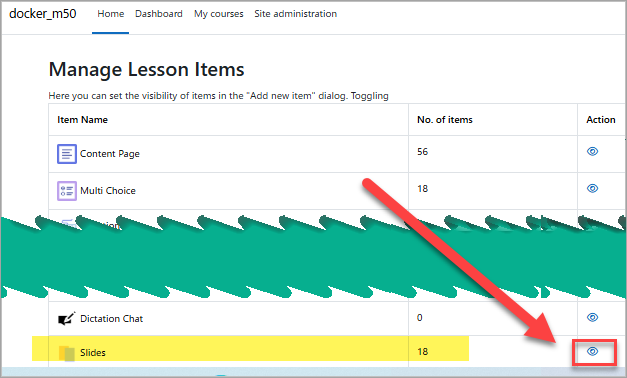
For existing users, new item types such as slides might require that you enable them. Do that at:
Site administration -> Plugins -> Activity Modules -> Poodll MiniLesson -> Manage Lesson Items
Editing Markdown
Though it is possible to create slides in HTML it is not as easy to use or edit as markdown. For more information on building slides in HTML see: https://revealjs.com/markup/
What follows is a list of simple markdown notation that can be used to build slides. It really is simple, which is good. If you need more functionality or layout control you should look at embedding a slideshow from somewhere e.g Google Slides. Note also that Markdown is sensitive to indentation, spaces and new lines. Notably when making a new slide, the slide marker should be left aligned. If all the content appears on one slide, check the left alignment.
You can see the some slides and edit/view the markdown in the item settings here:
https://demo.poodll.com/mod/minilesson/view.php?id=1862
Headings
To make a heading use the # character, followed by space and the heading text.
# Biggest heading
## Big heading
### Medium heading
New Slide
To make a new slide put 3 dashes at the beginning of a new line
---
New Vertical Slide
Vertical slides are navigated to with a down arrow. They allow you to put optional content that you (or the viewer) can skip or show. To make vertical slides use 2 dashes at the beginning of a new line.
--
Horizontal Line
To add a partition or horizonal line, use 5 dashes or 3 stars
***
-----
Text Highlighting
Use two stars(**text**) on either side of text for **bold**.
Use an underscore (_text_)** or a star(*text*) on either side of text for _italic_.
Bullet points
Use - for unordered lists
-An item
-Another item
Use 1. 2. etc for ordered lists
1. Item 1
2. Item 2
Images
Add an image name (alt tag) and file name like this:

NB Upload your image of that name into the files area below the markdown area
Tables
Use pipes (`|`)to create tables cells. You also need a line with just pipes and dashes(3 per column is enough) to separate the table header from the rows. The column size is figured out automatically, spaces don't do anything to make columns wider.
| id |food|animal |weather|
|----|------|------|----|
| 11 | cheese | elephant | cold |
| 22 | cake | alligator | hot |
Special Characters
Enclose special characters in back ticks to avoid them being parsed as markup when you want to just show them
three hyphens `---`
2 hashes `##`
Slide and Element Attributes (advanced)
You can change colors and font sizes etc with custom html comments right after the slide break
<!-- .slide: data-background="#ff0000" -->
To add classes like `fragment` to elements, use an HTML comment right after the element. Fragments basically just stage elements for arrival on-click (rather than go to the next slide)
Example List
- This item appears first. <!-- .element: class="fragment" data-fragment-index="1" -->
- This item appears second. <!-- .element: class="fragment" data-fragment-index="2" -->
- This item appears last . <!-- .element: class="fragment" data-fragment-index="3" -->
Layouts
By default the slide layout is single column horizontally centered. It is possible to implement 2 column, 3 column, 4 column and 2x2 grid layouts. using something like the following markup.
::: 2cols
::: col
## this is column 1
:::
::: col
## this is column 2
:::
:::
As explanation ..
a layout container is marked up with 3 colons in a row followed by one of: 2cols, 3cols, 4cols, or 2x2grid
The layout container is closed with 3 colons in a row by themselves.
a layout section is always 3 colons followed by col. ie ::: col
The layout section is closed with 3 colons in a row by themselves.
Reveal JS
Slides are made from a javascript library called Reveal JS. More information about that is here:
https://revealjs.com and here(for markdown) : https://revealjs.com/markdown
# The End
More detailed information on Markdown can be found here: